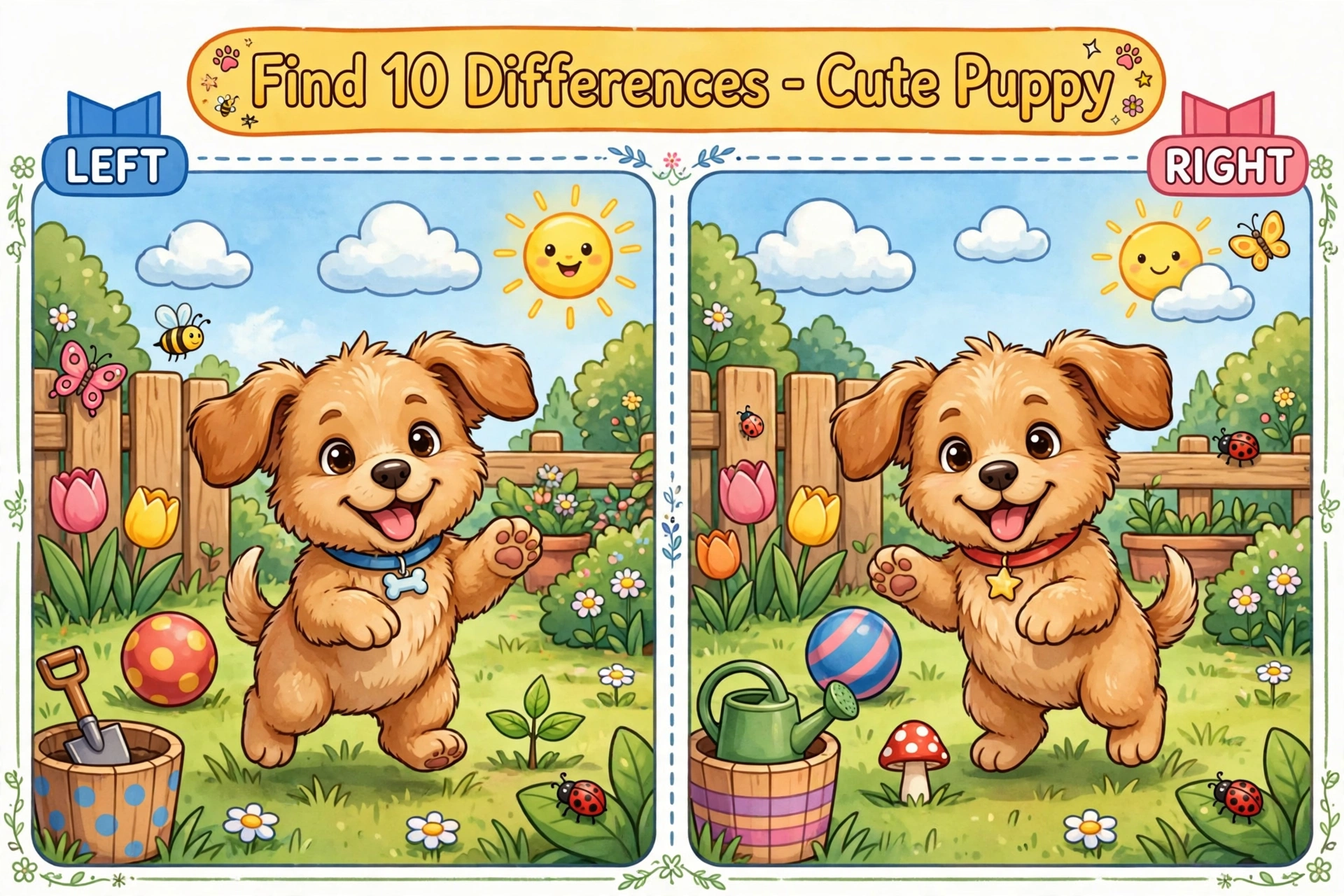
Find 10 Differences Image: Cute Puppy – Welcome back! Today, we have a tail-wagging, paw-sitively delightful activity that will have your little ones smiling from ear to ear. It’s time to sharpen those observation skills and dive into our latest puzzle: Find 10 Differences: Cute Puppy!
This adorable scene features a happy little puppy playing in a beautiful garden, surrounded by flowers, butterflies, and sunshine. But wait—things aren’t exactly as they seem! The image is split into two panels: LEFT and RIGHT. At first glance, they look identical. However, hidden within the cheerful details are 10 sneaky differences just waiting to be discovered.
Can you and your child spot all 10? Let’s grab our imaginary magnifying glasses and find out!
The Scene: A Puppy’s Perfect Day
Take a moment to look at the vibrant image above. We’ve created a joyful garden scene featuring a fluffy brown puppy with a big, happy smile. The puppy is surrounded by colorful tulips, a wooden fence, a bright sunny sky, and even a buzzing bee and a fluttering butterfly.
It’s a perfect day for play! But the LEFT and RIGHT images are not perfectly matched. This activity is designed to test observation, concentration, and attention to detail. It’s a classic “spot the difference” game that kids absolutely love, and it’s packed with educational benefits.
Why “Spot the Difference” is Essential for Child Development
We believe that play is the most powerful form of learning. This “Find 10 Differences” activity is more than just a fun game; it’s a brain-boosting workout for your child. Here is why this simple puzzle is so valuable:
1. Boosts Visual Perception and Attention to Detail
When children compare the left and right images, they are training their brains to notice minute details. They must scan the image systematically, looking at shapes, colors, and positions. This strengthens visual discrimination, a skill that is foundational for reading, writing, and even math.
2. Enhances Concentration and Focus
In a world filled with distractions, teaching a child to focus on a single task is a gift. Finding 10 differences requires patience and sustained attention. It encourages children to slow down, observe, and persist until they find the answer.
3. Develops Critical Thinking and Problem-Solving
As children compare the two scenes, they form hypotheses: “Is the puppy’s collar a different color?” “Did the butterfly move?” They learn to compare and contrast, which is a fundamental critical thinking skill used in science, math, and everyday life.
4. Improves Vocabulary and Communication
This activity is a fantastic conversation starter. As your child finds a difference, ask them to describe it. “The ball is red in one picture, but blue and pink in the other!” This encourages descriptive language, spatial terms (left, right, above, below), and color recognition.
5. Builds Patience and Perseverance
Some differences are easy to spot, while others might take a little longer. This teaches children that it’s okay to take your time and that persistence pays off. The feeling of accomplishment when they find the final difference is incredibly rewarding.
How to Play: A Step-by-Step Guide
Ready to get started? Here is the best way to tackle the Find 10 Differences: Cute Puppy puzzle with your little ones:
- Print or Display: For the best experience, print the image on a high-quality color printer. If you are viewing it on a screen, make sure the brightness is turned up so the colors are vibrant.
- Scan Systematically: Encourage your child not to just stare at the whole picture. Instead, suggest they scan from top to bottom, or left to right. Start with the sky, move to the fence, then the puppy, and finally the foreground.
- Compare and Contrast: Ask them to point to a specific object in the left image (e.g., the sun) and then find the exact same object in the right image. Do they look the same? Are the colors identical? Is anything missing?
- Use Descriptive Language: As they search, ask questions. “What color is the puppy’s collar?” “How many tulips are there?” “Is the shovel in the bucket?”
- Celebrate Every Find: Every time they spot a difference, celebrate! This keeps motivation high and makes the activity feel like a game rather than a test.
- Check the Answer Key: Once they think they’ve found all 10, review the image together to confirm their findings.
Hints to Help You Get Started
Stuck? Don’t worry! Here are a few gentle hints to guide you and your child toward the differences. Remember, the goal is to have fun, not to rush.
- Look at the Sky: Is the sun always the same? Check the clouds, too.
- Examine the Fence: Pay close attention to the little insects on the fence. Are they the same in both pictures?
- Check the Puppy: The puppy is a great place to look. Check the collar and the tag. Is it the same shape and color?
- Inspect the Ball: Look closely at the ball on the ground. Is it the same pattern and color in both scenes?
- Focus on the Foreground: Look at the bucket on the ground. What is inside it? Does it match in both pictures?
- Don’t Forget the Flowers: Count the tulips and look at their colors. Is there an extra one in one of the scenes?
The Educational Benefits of Puppy-Themed Learning
Using a cute puppy as the backdrop for this activity is intentional. Animals, especially puppies, are wonderful for early childhood education because they connect children to nature, empathy, and responsibility. By engaging with this image, children are subtly learning about:
- Animal Recognition: Dogs are familiar and beloved, helping children identify common pets and their features.
- Color Recognition: The bright tulips, the blue sky, and the puppy’s brown fur provide excellent opportunities to practice color names.
- Spatial Awareness: Understanding the relationship between objects (e.g., the puppy is next to the ball, the fence is behind the flowers) is a key math and geography skill.
- Storytelling: Encourage your child to make up a story about the puppy. What is its name? What is it playing with? This sparks imagination and narrative skills.
Expand the Learning: Beyond the Puzzle
Once your child has successfully found all 10 differences, the learning doesn’t have to stop! Here are some extension activities you can try:
- Coloring Fun: Print out the puppy scene in black and white and let your child color it in. This reinforces fine motor skills and allows them to express their creativity.
- Count and Graph: Ask your child to count how many flowers, butterflies, or ladybugs they see. Create a simple bar graph to visualize the numbers.
- Write a Story: Have your child write a short story about the puppy’s adventure in the garden. What happens next?
- Draw Your Own Puppy: Encourage your child to draw their own puppy in a garden, with their own unique flowers and toys.
Conclusion: Learning Through Play
We are passionate about creating resources that make learning joyful. The Find 10 Differences: Cute Puppy activity is a perfect example of how a simple game can pack a powerful educational punch. It combines fun, focus, and foundational skills in one delightful package.
So, gather your little ones, print out the image, and embark on a puppy-filled adventure together. Can you spot all 10 differences? We bet you can! Remember, the goal is to have fun, learn something new, and enjoy the wonderful world of playful education.
Stay tuned for more exciting coloring pages, worksheets, and educational activities designed to help your child grow smart and play happy. Happy hunting!
Answer Key (For Parents & Educators Only!)
Spoiler Alert! Don’t read this until you’ve found all 10!
- Sun: The sun has a smiling face in the LEFT image, but the RIGHT image has a cloud covering part of it (or a different expression).
- Butterfly: There is a pink butterfly on the fence in the LEFT image, but a yellow butterfly near the sun in the RIGHT image.
- Bee/Ladybug: The LEFT image has a bee near the fence; the RIGHT image has a ladybug on the fence.
- Puppy’s Collar: The collar is BLUE in the LEFT image, but RED in the RIGHT.
- Collar Tag: The tag is a BONE shape in the LEFT image, but a STAR shape in the RIGHT.
- Ball: The ball is RED with YELLOW dots in the LEFT image, but BLUE and PINK striped in the RIGHT.
- Bucket Content: The bucket contains a SHOVEL in the LEFT image, but a GREEN WATERING CAN in the RIGHT.
- Mushroom: There is no mushroom in the LEFT image, but a RED MUSHROOM appears in the RIGHT.
- Flowers: The tulip colors and count differ (e.g., an extra orange tulip appears in the RIGHT image).
- Puppy’s Paw: The puppy is waving with a different paw, or the paw position is slightly different between the two images.